
Berkeley Nucleonics Corp.
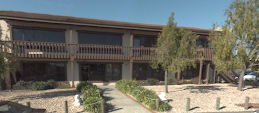
Manufacture of Digital Delay Pulse Generator
Showing posts with label berkeley nucleonics. Show all posts
Showing posts with label berkeley nucleonics. Show all posts
Tuesday, March 19, 2013
APS TV - New Feature at APS 2013 Conference
Pretty cool feature offered at APS this year. A dedicated channel shown throughout the Convention Center as well as at partnered hotels so attendees can always be dialed into the conference.
Learn More..


APS Conference 2013 - Baltimore, MD
Come by our booth to see our new RF / Microwave Signal Generators, Femtosecond Digital Delay Generators and our industry leading Isotope Identifiers.
Tuesday, February 26, 2013
New Isotope Identifier Operating System - Eagle OS 3. 8. 5
Berkeley
Nucleonics, a California scientific instrumentation manufacturer, has
officially released Eagle 3.8.5, a powerful update to it’s Isotope
Identification Algorithms and Handheld Instrumentation Operating system.
New features in the OS, which can be field updated, address common
requirements from users across different disciplines. Workers in radiation
safety, health physics or emergency response are all benefitting from features
such as:
-
Enhanced
“Review Spectra” capabilities
-
Customizable
Trigger Lists (CTL) can be created by
the user on a PC with factory assistance.
-
Food
Contamination Measurements - users gain the ability to quantify radiation contamination
in the field along with their real time radionuclide identification.

With the latest
release of the Eagle Operating System 3.8.5, BNC provides users of the SAM 940 with
a quick review feature to display the most recent spectra(s) captured at the
push of a button. Another handy feature
is to review only the most recent 10 Spectra.
Customized
Trigger Lists (CTL) allow users to set up instrumentation for application
specific activities. Because the SAM isotope identifiers serve a cross section
of user fields, we have added CTLs so users can narrow down the windows of
isotopes of interest. An inspector may have a very different mission
requirement than a hospital Radiation Safety Officer. CTLs enable quick program
management and simplify the end-user tasks.
The Food
Contamination Measurement feature enables users to make readings, presumably in
a known geometry, and then convert the radiation levels into contamination in
Becquerel / Kilogram. A computer is not required and the data need not be
transferred off of the SAM 940 Isotope Identifier.
New Feature - Review Recent Spectra
Quickly
refer to your ten most recently acquired Spectrum Reports
Starts with the most
recent, then press Previous to review the next most recent spectra in
descending order.
New Feature – Custom Trigger List / Custom
Nuclide Library
The default trigger
list is the ANSI list, but a new “User” trigger list can be selected in the
Field Settings menu, and this “User” list can be easily edited by using PC with
a CF card reader.
New Feature – Food Contamination Measurements
Measure radiation
activity in food, water, and soil samples.
Menu driven instructions to easily perform the necessary Efficiency
Calibrations for making these specific measurements.

Berkeley Nucleonics Corporation is a leading manufacturer of precision
electronic instrumentation for test, measurement and nuclear research. BNC has
its corporate headquarters in San Rafael, California with several additional
manufacturing facilities and sales offices located throughout the United
States. Founded in 1963, BNC has been a recognized leader in the field of
isotope identification and conducts hundreds of short courses on radiation
detection and isotope identification for Federal and State agencies.
Tuesday, February 12, 2013
Workshop on RF and Microwave Signal Generation and Measurement Coincides with APS Conference
A free workshop covering
techniques for RF/Microwave signal generation and measurements is available to
the technical community during the 2013 American Physics Society annual
meeting. A total of 120 spots are available on a first come first serve basis
with registration available at http://info.berkeleynucleonics.com/APS-2013
.
The workshop is sponsored by
Berkeley Nucleonics (BNC Corp) and is held as part of the APS conference just
after exhibit hours at the Hilton
Baltimore, Key Ballroom 3 on Tuesday, March 19 from 5:30‐7:30PM. BNC will also have a booth at the APS Show
which runs from March 18 - 22. This workshop will give researchers and
engineers in the RF/Microwave field an in-depth overview of techniques for
signal generation and measurement, along with hands on activities using
instrumentation and software tools. “The
APS Conference was selected as one of several venues well suited for this
workshop by Berkeley Nucleonics,” comments Alex Palm, RF Product Line Manager.
“The community of Physicists attending cover a wide range of applications and
demand is growing for RF and Microwave products and training.” The American Physics Society is widely
recognized as the leading US
The use of RF and Microwave signal generators has exploded as communications
and defense requirements worldwide grow rapidly. The increasing demand of wireless devices create a need for higher frequencies,
stimulating job opportunities and industrial growth in critical market segments
such as radar, remote sensing, remote control, sensors, navigation,
surveillance, electronic warfare, radiometers, plasma research, and imaging.
About the Company -- Berkeley Nucleonics is a leading
manufacturer of Pulse and Digital Delay Generators, Function/Arbitrary Waveform
Generators and RF/Microwave Signal Generators. The company recently introduces
the Model 845 20GHz Signal Generator, a breakthrough in performance, size and
low power consumption. BNC has
its corporate headquarters in San Rafael, California with several additional
manufacturing facilities and sales offices located throughout the United
States. Founded in 1963, BNC has been a recognized leader in the Test and
Measurements field.
Friday, January 4, 2013
Berkeley Nucleonics offers full-featured high performance alternative to big-ticket microwave / rf equipment
Berkeley Nucleonics announces the Model 835-M 3GHz
RF / Microwave Signal Generator. The modular packaging offers users an extremely
versatile Microwave and RF signal source, loaded with features and specifications
at the top of it’s class. With the latest developments in component technology,
the company can offer this capability at prices unseen prior.
Two model options allow frequency
ranges from 9kHz to 3GHz and 9kHz to 20GHz respectively, with very low phase
noise, fast switching speeds, full sweeping functions, and extensive modulation
in a small package. This product is useful for experimenters requiring high
performance and many traditional features yet fighting a constrained budget.
Programming and control
are performed through various interfaces such as USB A/B and Ethernet. We have
removed a front panel interface on the Model 835-M to reduce size and cost. A
comprehensive soft-panel GUI is included, providing intuitive PC or Linux-based
programming. SCPI programming is also a standard feature. An API library is
provided that can be used to control the sources via Linux in a simple and
straightforward method. An National Instruments Certified LABView driver is in
development and the company expects a release date of 02/13.
 Innovative design
techniques and component breakthroughs allow Berkeley Nucleonics to combine
improved flexibility in features with and budget-stretching price points. In addition to high performance
instrumentation, BNC is recognized for excellent customer service and technical
support, offering a standard 2-year warranty and same-day overnight shipments
on the RF line. A Live-Chat module at www.berkeleynucleonics.com gives
users access to Application Engineers at all times..
Innovative design
techniques and component breakthroughs allow Berkeley Nucleonics to combine
improved flexibility in features with and budget-stretching price points. In addition to high performance
instrumentation, BNC is recognized for excellent customer service and technical
support, offering a standard 2-year warranty and same-day overnight shipments
on the RF line. A Live-Chat module at www.berkeleynucleonics.com gives
users access to Application Engineers at all times..
“Our RF line of Signal
Generators represent some fantastic R&D. Product development cycles have
shortened and end users expect innovative designs on a continuous basis. We are
committed to advancing the technology quickly and have a slate of new products
in development for 2013 also”, remarked David Brown, Company President.
Berkeley Nucleonics Corporation is a leading
manufacturer of precision electronic instrumentation for test, measurement and
nuclear research. BNC has its corporate headquarters in San Rafael, California
with several additional manufacturing facilities and sales offices located
throughout the United States. Founded in 1963, BNC has been a recognized leader
in the Test and Measurements field.
For additional information on Microwave / RF
instrumentation, please visit www.berkeleynucleonics.com or call (800)234-7858
Wednesday, November 21, 2012
Berkeley Nucleonics at IEEE 2012 in Anaheim, CA
Monday, November 12, 2012
BNC Celebrates 25 Year Partnership with PT Systems
Berkeley Nucleonics (BNC) President David Brown visited one of it's California contract manufacturing firms last week to celebrate 25 years of cooperation. PT Systems Inc (Concord, CA) is a select manufacturer for Berkeley Nucleonics, manufacturing BNC designs in Test, Measurement and Nuclear Research. "Using local manufacturing allows us to easily interface on design, specifications and mechanical issues", comments Brown.


Wednesday, October 10, 2012
New Microwave RF Signal Generator
Berkeley Nucleonics Sets Industry Benchmark With Introduction Of New Microwave Signal Generator / Rf Signal Generator Frequency Sources
Berkeley Nucleonics commercially releases a full line of high performance, robust, and extremely cost effective Microwave / RF signal generators. This Microwave / RF product line sets a new standard in performance to cost. Capable of producing in excess of 20GHz, with very low phase noise, fast switching speeds, extensive modulation capabilities in a variety of packaging options, including benchtop, portable battery operation, 1U 19” rackmount, and card-level for OEM integration. These instruments offer the widest array of options to meet almost any application requirement.
 Modern design techniques and component breakthroughs allow Berkeley Nucleonics to combine improved flexibility in features with and budget-stretching price points. “We are very excited to bring these new Microwave Source solutions to our customers”, states David Brown, President of Berkeley Nucleonics. “We are addressing the requirements for faster switching speeds in modulation and sweep routines with this product. The demands of today’s R&D engineers in applications like cellular, satellite and communications are rigorous. It is a timely product as we celebrate 50 years of signal generator manufacturing for the scientific community.”
 Excellent quality, performance, and price are only part of the unique attributes that BNC offers its customers. The company is also known for excellent customer service and technical support, offering a standard 2-year warranty, same-day overnight shipments, Live-Chate with Application Engineers through it’s website and flexible customization options.
About The Company :
Berkeley Nucleonics Corporation is a leading manufacturer of precision electronic instrumentation for test, measurement and nuclear research. BNC has its corporate headquarters in San Rafael, California with several additional manufacturing facilities and sales offices located throughout the United States. Founded in 1963, BNC has been a recognized leader in the Test and Measurements field.
For additional information on Microwave / RF instrumentation, please visit www.berkeleynucleonics.com or call (800)234-7858
Press Contact: Technical Contact:
Bernadette Jamiason Alex Palm
800-234-7858 x205 (707)291-3073
Excellent quality, performance, and price are only part of the unique attributes that BNC offers its customers. The company is also known for excellent customer service and technical support, offering a standard 2-year warranty, same-day overnight shipments, Live-Chate with Application Engineers through it’s website and flexible customization options.
About The Company :
Berkeley Nucleonics Corporation is a leading manufacturer of precision electronic instrumentation for test, measurement and nuclear research. BNC has its corporate headquarters in San Rafael, California with several additional manufacturing facilities and sales offices located throughout the United States. Founded in 1963, BNC has been a recognized leader in the Test and Measurements field.
For additional information on Microwave / RF instrumentation, please visit www.berkeleynucleonics.com or call (800)234-7858
Press Contact: Technical Contact:
Bernadette Jamiason Alex Palm
800-234-7858 x205 (707)291-3073


Monday, August 22, 2011
A New Activity, Safecasting


A community has formed around the globe of individuals who are using Berkeley Nucleonics and other Radiation Detection devices (SAM Isotope Identifier Shown) for streaming data on background radiological levels to a google map online. The updates are sent with various GPS apps from the Android Market and from the Iphone Market. Data is typically in Rem or Sieverts.
Monday, July 25, 2011
Robots Investigate Fukushima Facilities
Fukushima uses advanced Robots to climb stairs and investigate facilities. Berkeley Nucleonics has deployed hundreds of radiation detection systems for isotope identification in Asian regions. Our most common units generate radiological data coupled with GPS data and the results are available online at www.berkeleynucleonics.com
http://youtu.be/ggr315PprFM
http://youtu.be/ggr315PprFM
Monday, June 27, 2011
Berkeley Nucleonics - SAM 940 Isotope Identifier

Double-fisted....the technicians at Berkeley Nucleonics are testing RIIDs (radionuclide isotope identification devices) to meet a surge in demand following Fukushima. Model SAM 940 Revealer shown above with Lanthanum Bromide.
Tuesday, June 7, 2011
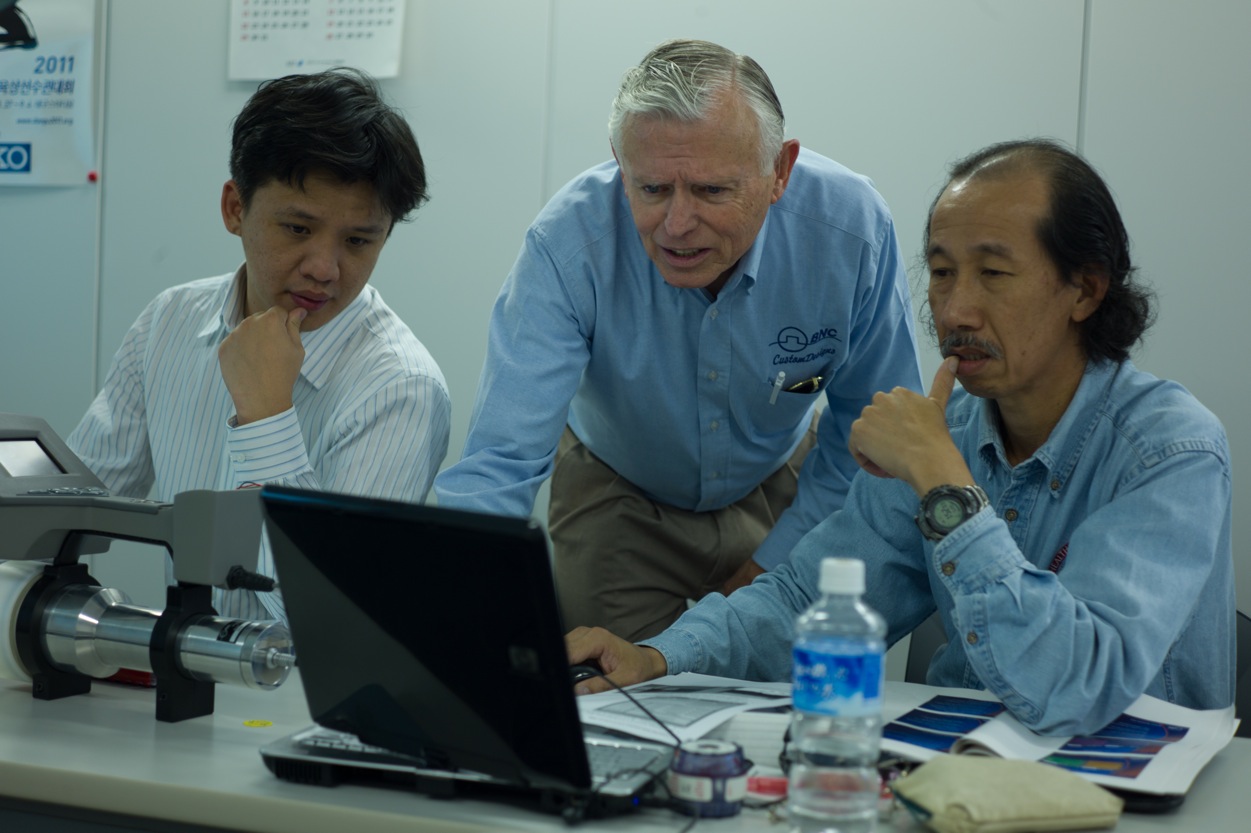
BNC Training in Japan
Berkeley Nucleonics sent a team of trainers to Japan to work with local agencies and end users in addressing some of the nuclear concerns. Berkeley manufactures the fastest room-temperature isotope identifier available, routinely identifying sources in a couple seconds with accurate results.



Tuesday, April 12, 2011
Japan Atomic Crisis Reaches Chernobyl Level

Japan raised the severity rating of its nuclear crisis to the highest, matching the 1986 Chernobyl disaster, after increasing radiation prompted the government to widen the evacuation zone and aftershocks rocked the country.
Japan’s Nuclear and Industrial Safety Agency yesterday raised the rating to 7. The accident at the Fukushima Dai-Ichi plant previously was rated a 5 on the global scale, the same as the 1979 partial meltdown at Three Mile Island in Pennsylvania.
Read more by clicking the link.
http://www.businessweek.com/news/2011-04-12/japan-atomic-crisis-reaches-chernobyl-level-as-radiation-climbs.html
Tuesday, April 5, 2011
Berkeley Nucleonics Radiation Detection Products Used In Japan

In response to the Japanese nuclear power plant disaster, Berkeley Nucleonics has delivered 100's of radiation detectors to US and Japanese nationals who are working in and around the contaminated facility. We have donated numerous shipments and continue to provide around-the-clock support for end users and regional service and training centers. For a list of agents in Asia, please see our International Pull-Down Menu. The SAM Isotope Identifier has been updated with Eagle-A, a new firmware to quickly identify low levels of Cs-134, Cs-137 and I-131.
Click http://www.globaldirt.org/map/ to see the actual readings from our SAM 940 Isotope Identifier. This data was taken by a Global DIRT assessment team within 2km (1.2 miles) of the Fukushima I Nuclear Power Plant. Data was collected using a Berkeley Nucleonics Corporation SAM 940 Defender / Revealer. The map below represents only readings which contained isotope levels (about 451 of the 1654 current readings). Be sure to check back as this page will be constantly updated.
About Berkeley Nucleonics
BNC’s radiation detection products are popular for detection, dosimetry and isotope identification and in use by HazMat teams, firefighters, first responders, and border protection personnel. Analytical products offer real time medical, industrial, SNM and NORM nuclear isotope identification. From pager to portal, we understand detection and spectroscopy applications. BNC offers an accredited training program which provides attendees with a comprehensive understanding of the principles and techniques involved in radiation detection and isotope identification. This program also provides CEUs and can educate new and experienced users. Regional courses or on-site, our trainers can deliver. Give us a call or try our Live Online Help…800-234-7858
Monday, April 4, 2011
Trace Radiation Levels from Japan detected by U.S. EPA RadNet System—

Albuquerque, New Mexico. April 1, 2011. During the past three years, EDi has maintained the U.S. Environmental Protection Agency’s (EPA’s) RadNet system, which consists of more than 100 radiation-monitoring stations throughout the United States. Lately, these monitoring stations track and record the released radiation from the Fukushima Daichii Nuclear Power Plant severely damaged during the earthquake and tsunami that recently devastated Japan on March 11, 2011.
The RadNet Program, initially established to monitor radiation associated with nuclear weapons testing, was later expanded to include radiation levels during emergencies. For more than 30 years, RadNet has developed an important environmental radiation database used by the EPA and other federal agencies.
The RadNet mission is to monitor environmental radioactivity in the United States providing high quality data for assessing public exposure and environmental impacts resulting from nuclear emergencies and to provide baseline data during routine conditions. RadNet has three (3) specific objectives:
1. Provide data for nuclear emergency response assessments;
2. Provide data on ambient levels of radiation in the environment for baseline and trend analysis; and
3. Inform the general public and public officials.
EDi performs a variety of calibration, repair, and technical support services for the monitoring devices—both on site and at our San Antonio, TX service facility. Services include maintenance of the central processing unit (CPU), all telemetry and weather-monitoring subsystems, and sensors.
About EDi
Headquartered in Albuquerque, New Mexico, EDi is a Small Business Administration (SBA) certified woman- and minority-owned small disadvantaged business entity with a strong reputation for providing quality technical environmental services. Recognized as an industry leader, EDi specializes in the detection, identification, characterization, and decontamination of hazardous and radioactive environments. Founded in 1990, EDi began by providing radiological and industrial hygiene support services to Los Alamos and Sandia National Laboratories and has since expanded its capabilities and market areas. Today, EDi has offices in New Mexico, Colorado, Texas, Tennessee, and Washington, D.C.
For more information about EPA’s RadNet program, visit: http://www.epa.gov/japan2011/
For more information about EDi and the Radcon Services we provide, visit: http://www.edi-nm.com
Friday, April 1, 2011
An Overview of X-Ray Spectroscopy

The purpose of this book is to discuss X-ray microanalysis and computer-aided imaging at a level that promotes an understanding beyond merely “how-to” texts, but without overwhelming the reader with volume or complexity. No attempt is made to replace a full textbook for either technique. Rather, this volume is meant to be an introduction for newcomers to the fields and a reference for experienced microscopists to be reviewed as needed. More in-depth texts and articles, which include derivations of the mathematical relationships, are given as references for those who desire such information. Several tables and diagrams of relevant information are provided for quick reference.
http://www.berkeleynucleonics.com/resources/MicroscopyBook.pdf
Thursday, March 31, 2011
Singapore Government Suspends Import of Food from Japan

AVA SUSPENDS IMPORT OF FRUITS AND VEGETABLES FROM KANTO REGION IN JAPAN
Detection of radioactive contaminants in another two samples of vegetables from Japan
Radioactive contaminants have been detected in another two samples of vegetables from Japan. The contaminated samples were imported from the prefectures of Kanagawa and Tokyo. In addition, the Japanese Ministry of Health, Labour and Welfare had reported the detection of high radioactivity levels in some vegetables from Saitama.
2. In view of the latest developments, the Agri-Food & Veterinary Authority (AVA) will extend its suspension on the import of fruits and vegetables to include the prefectures of Kanagawa, Tokyo and Saitama. This means the entire Kanto Region of Japan is now suspended from exporting fruits and vegetables to Singapore as AVA had earlier suspended the Kanto prefectures of Ibaraki, Tochigi, Gunma and Chiba.
Status of suspension of Japan food imports
3. The status of our suspension of food imports from Japan as at 26 Mar 2011 is as follows:
Source
Item
Fukushima, Ibaraki*, Tochigi* and Gunma*
Milk, milk products, seafood, meat, fruits and vegetables
Ehime, Chiba*, Kanagawa*, Tokyo* and Saitama*
Fruits and vegetables
* Prefectures in the Kanto Region
Food imports from Japan subjected to “hold-and-test”
4. Since 25 Mar 2011, all consignments of fruits and vegetables, seafood, meat, milk and milk products imported from Japan have been subjected to hold-and-test. This means that the products will only be released for sale when test results show that there is no radioactive contamination. If radioactive contaminants are detected in any sample, the affected shipment will be disposed.
Agri-Food & Veterinary Authority of Singapore 5 Maxwell Road #04-00 Tower Block MND Complex Singapore 069110 Fax: (65) 62235383
Updates on test results
5. To date, 287 samples of fruits and vegetables, seafood, meat, milk and milk products have been tested. The latest results of samples collected from shipments imported on 25 and 26 Mar 2011 showed that radioactive contaminants were found in the following two samples of vegetables :
Item (Source)
Detection levels
Iodine-131
Cesium-134
Cesium-137
Cabbage (Kanagawa)
936bq/kg
242bq/kg
474bq/kg
Leek (Tokyo)
226bq/kg
-
-
* Becquerel (bq) is a measurement of radioactivity levels. The Codex guidelines for radionuclides in food (other than infant food) for Iodine 131 is 100 bq/kg, Cesium 134 is 1000 bq/kg and Cesium 137 is 1000 bq/kg.
** Test results are provided by the Health Sciences Authority’s Applied Sciences Group
No cause for alarm for consumers
6. Food imported from Japan that is available in the market is safe for consumption. There is no cause for concern for consumers as the affected consignments have not been released for sale under our “hold-and-test” surveillance programme.
7. AVA will continue to closely monitor and test food imports from Japan.
8. The public could visit the Japan Earthquake microsite at www.gov.sg (www.gov.sg/japanquake) for latest updates and information from the authorities. They could also visit AVA site at www.ava.gov.sg.
Issued by Agri-Food & Veterinary Authority
On 26 Mar 2011
ANNEX A
Source : http://mapsof.net/japan/static-maps/png/regions-and-prefectures-of-japan
Friday, March 25, 2011
Semiconductor applications for Berkeley Nucleonics Pulse and Digital Delay Generators

Semiconductor applications for Berkeley Nucleonics Pulse and Digital Delay Generators were discussed at the Shanghai Photonics conference last week. Teltec Semiconductor, Berkeley's local agent, gave product demonstrations to numerous R&D engineers developoing the next generation of wafer technology for a re-emerging semiconductor industry. New mobile applications and in-vehicle wi-fi systems lead the way as manufacturers find ways to adjust to new market needs.
The Berkeley Nucleonics Digital Delay Generators offer 8 channels of delay and width with resolution down to 1 picosecond. The BNC line also offers the worlds lowest trigger jitter which is measured under 10 picoseconds. The company offers a range of products from it's factory in California and through domestic and international service centers. The applications team at Berkeley Nucleonics is available by phone during the day or around the clock on the website by clicking LIVE HELP. For more, go to www.berkeleynucleonics.com
About Berkeley Nucleonics
Berkeley Nucleonics was founded in 1963 as a spin-off of the Lawrence Berkeley National Laboratory (LBNL) in Berkeley, California. The company manufactures lines of instrumentation for medical, nuclear, physics and chemistry fields. Customers are serviced by a network of approximately 50 international and domestic agents and service centers. The company is routinely cited for contributions to the advanced research of US federal agencies and various large academic institutions. New products for 2011 include a 16 Channel Pulse and Delay Generator, an Arbitrary Waveform Generator, a 40pS Universal Counter / Time Interval Counter and a growing line of 100MHz – 500MHz Oscilloscopes.
Tuesday, March 22, 2011
Berkeley Nucleonics Featured in New York Times Article

http://www.nytimes.com/2011/03/22/business/22geiger.html?_r=2
Article Excerpt :
Many people buying the devices say they are worried about their food becoming contaminated. One customer, Mr. Flanegin said, was a theme park in Japan that wanted to check its food supplies as a precaution for its visitors.
Radiation detectors come as hand-held devices, wrist watches and pager-size gadgets that hang from the belt. Their cost varies from $150 for a self-assembled kit to $4,000 for a more sophisticated version that stores radiation readings along with the GPS coordinates of where those readings were taken.
Technically, Geiger counters are just one type of radiation detector. But many people use the term to describe all radiation detection equipment.
Law enforcement, fire departments, military, hospitals, scientific laboratories, schools and prospectors are the typical customers. Federal government agencies seem to be well enough stocked that they are not scrambling to buy more, according to the sellers interviewed.
Usually, the general public, other than a small group of hobbyists, has little interest in radiation.
But that changed after a devastating earthquake and tsunami set off Japan’s nuclear troubles. Demand for radiation detectors, along with potassium iodide pills, which can help prevent radiation-induced thyroid cancer, quickly outstripped supplies and the limited capacity to produce more.
Skepticism that the government will be forthcoming about radiation levels is driving some of the sales, said John Iovine, president of Images SI, a company in Staten Island that makes and sells Geiger counters and other scientific instruments.
“I never really felt it until people started calling up,” he said. “They want their own Geiger counter to check up.” Radiation levels in the United States remain within the normal range, according to the Environmental Protection Agency, which has a network of monitors across the country. Updates are available on the E.P.A.’s Web site.
During a typical week, Mr. Iovine says, he may get an order for 20 Geiger counters from a local government followed by several weeks without any additional sales. But in the week after the Japan earthquake, he said he received close to 200 orders and was now sold out. Customers are now warned that it will take six to eight weeks to fill any orders.
Still, buying a radiation detector is just the first step, Mr. Iovine said. Owners of the devices need to discern between dangerous radiation levels and a normal background reading.
“To use it is very simple,” Mr. Iovine said. “To interpret the results gets a little more difficult.”
Naturally occurring radiation varies depending on factors like local geology and altitude. People are exposed to additional radiation when they get an X-ray or fly in an airplane.
Robert Corsetti, director of sales and marketing for Berkeley Nucleonics, which makes and sells industrial-grade radiation detection equipment, said that calls to his company, which is based in San Rafael, Calif., increased up to 15 times the normal level after the problems started in Japan. In some cases, people are simply calling to ask if they are at risk, and not to buy something.
“We send out PowerPoints that dispel rumors,” Mr. Corsetti said. “I send the e-mail 20 times a day.” In one case, he said, an airline pilot who regularly flies to Tokyo wanted a detector to determine if he was being exposed to more radiation than usual. NBC News crew members in Japan are using radiation detectors from Berkeley Nucleonics that they can wear on their belts, much like beepers. The devices sound an alarm when they detect excessive radiation and when the dose exceeds a specified level over time.
In addition to the detectors, NBC News personnel are equipped with protective masks and suits, along with access to potassium iodide pills.
Monday, March 21, 2011
Shipment of Radiation Detectors to Mizuno Pharmacy, Tokyo Japan.

Shipment of Radiation Detectors to Mizuno Pharmacy, Tokyo Japan.
Berkeley Nucleonics shipped PRD units to Mizuno Pharmacy in Tokyo today in an effort to advise patients and clinical staff about fallout concerns after a reactor incident at Fukushima Nuclear Power Plant. The PRD from Berkeley Nucleonics measures dose rates, counts per second and accumulated dose, making it useful for a wide range of applications.
“The service I received from Berkeley Nucleonics has been exception in these trying times,” commented Barbara Chang in a telephone discussion.
Radiopharmaceutical companies are one of many industries with routine exposure to medical and industrial nuclear radiation. Radio Isotopes are used in a wide range of industries and occur in many natural forms as well. Such benign articles as ceramics or kitty litter carry small levels or radiation. Patients who receive medical treatments, often with Iodine-131, are also subject to radiation concerns. The PRDs and a broader family of detector systems provide instant results and characterization of the ionizing radiation. Previous TLD systems absorbed dose over long periods of time but required special readers or 3rd party service providers to inform the holder of actual exposures. The company has ramped up production and is planning additional shipments of PRDs and Isotope Identifiers to Japan I the coming weeks.
Press Contact:
Bernadette Jamieson, 800-234-7858 x210, bernadette.jamieson (at) berkeleynucleonics (dot) com
Technical Contact :
Robert Corsetti, 800-234-7858 x250, robert.corsetti (at) berkeleynucleonics (dot) com
About The Company :
Berkeley Nucleonics Corporation (BNC) has a 45 year history providing precision electronic instrumentation for test, measurement and nuclear research. Our products include signal / pulse generators and digital delay generators (DDG), multimeters and frequency counters, radiation detectors (RIID) and life sciences instrumentation. Flagship instruments include a 250pS 8-Channel Digital Delay Generator, a NIM Precision Pulse Generator and ANSI compliant handheld isotope identifers (RIID) and radiation pagers (PRD). We offer users around-the-clock support on our products and can customize a suite of instruments to meet the most demanding applications.
BNC’s radiation detection products are popular for detection, dosimetry and isotope identification and in use by HazMat teams, firefighters, first responders, and border protection personnel. Analytical products offer real time medical, industrial, SNM and NORM nuclear isotope identification. From pager to portal, we understand detection and spectroscopy applications. BNC offers an accredited training program which provides attendees with a comprehensive understanding of the principles and techniques involved in radiation detection and isotope identification. This program also provides CEUs and can educate new and experienced users. Regional courses or on-site, our trainers can deliver. Give us a call or try our Live Online Help...800-234-7858
Subscribe to:
Posts (Atom)